Search and Rescue Mission Using Turtlebot
Introduction
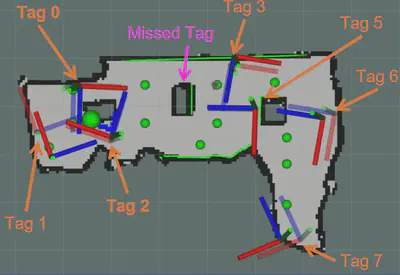
In response to the critical need for effective reconnaissance in disaster scenarios, this research article presents the design and implementation of a complete autonomous robot system using the Turtlebot3 Burger (TB3) with Robot Operating System (ROS) Noetic. Upon deployment in closed, initially unknown environments, the system aims to generate a comprehensive map and identify any present ’victims’ using AprilTags as stand-ins. We discuss our solution for search and rescue missions, while additionally exploring more advanced algorithms to improve search and rescue functionalities. We introduce a Cubature Kalman Filter (CKF) to help reduce the Mean Squared Error (MSE) [m] for AprilTag localization and an information-theoretic exploration algorithm to expedite exploration in unknown environments.
This project we addresses the need for an autonomous robotic system that can both map unknown, closed environments and identify “victims(AprilTags)” in these settings. Our goal is to design and implement a robust system using the Robot Operating System (ROS) Noetic, which can:
• Generate a complete occupancy grid map of an unknown environment, providing essential data for navigation and strategic planning.
• Locate and accurately estimate the poses of “victims,” represented by AprilTags, to simulate the identification and location of individuals in need of rescue.
Method
Frontier Detection1 (background):
Detection of new frontier cells (and erase old ones).
Form frontiers from frontier cells.
Compute Exploration Goal2,3 (service request):
Sample free points around each frontier’s centroid.
Compute gain for each point (optimizes yaw)
Return highest gain pose as exploration goal.
Videos
Demo Video Trial 1
Demo Video Trial 2
Read more about it on !Report