3D Reconstruction Using Structure From Motion (SfM)
Objective
To reconstruct a 3D scene and camera trajectory from a sequence of images using Structure-from-Motion (SfM). The pipeline includes feature detection, pose estimation, 3D point triangulation, and bundle adjustment for optimization.
Dataset
Source: A custom dataset of images depicting a static scene (“buddha_images”).
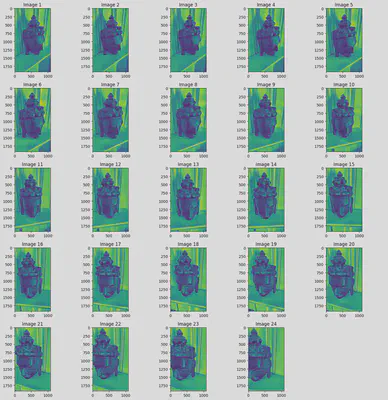
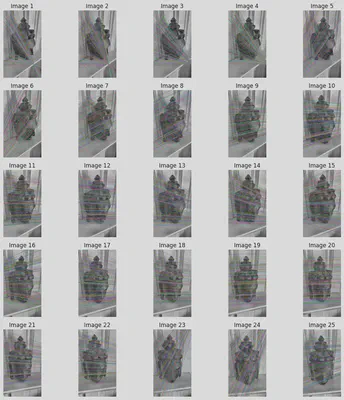
Details: The dataset consists of 25 images captured from different perspectives, simulating real-world camera motion around the object.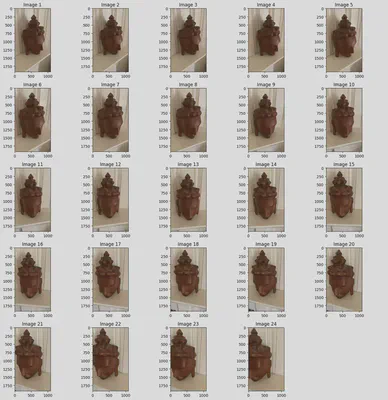
Preprocessing: Images are normalized to ensure uniform pixel intensity. CLAHE (Contrast Limited Adaptive Histogram Equalization) is applied for better feature detection in low-contrast regions.
Problem Statement
The goal is to accurately reconstruct the 3D structure of the scene and estimate the camera trajectory by:
- Detecting and matching features across the images.
- Estimating relative camera poses and 3D points.
- Refining the reconstruction with bundle adjustment to minimize reprojection errors.
Workflow
1. Image Preprocessing
Images are loaded and enhanced to improve feature detection.
Conversion to grayscale and CLAHE is applied for contrast improvement.
2. Feature Detection and Matching
SIFT (Scale-Invariant Feature Transform) is used to detect robust keypoints in each image.
Keypoints are matched between consecutive images using FLANN-based matching.
RANSAC is applied to eliminate outliers and ensure reliable matches.
3. Pose and Structure Estimation
Fundamental Matrix: Estimated using RANSAC for epipolar geometry constraints.
Essential Matrix: Extracted from the fundamental matrix to estimate relative camera poses.
3D Point Triangulation: Feature correspondences are triangulated to estimate initial 3D points.
Framework: GTSAM is used to build a factor graph that models the relationship between camera poses and 3D points.
Optimization:
    Camera poses and 3D points are refined by minimizing reprojection errors.
    The Levenberg-Marquardt algorithm is employed for nonlinear optimization.
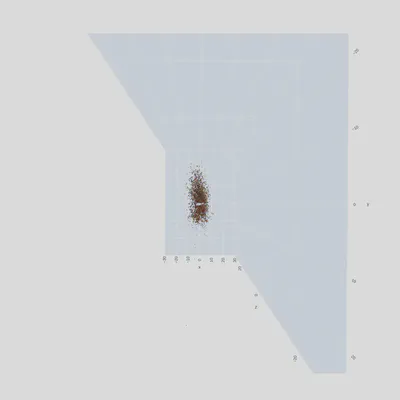
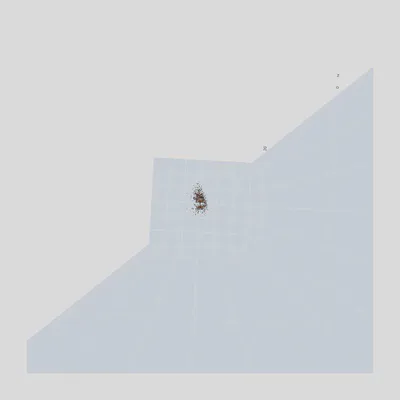
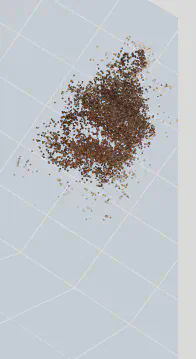
5. Visualization The 3D reconstruction is visualized as: A point cloud representing the reconstructed scene. A trajectory showing the path of the camera during image capture.
Output